Seasonal Guide · 9 min read · June 1, 2026
When and Where to Find Morel Mushrooms in Washington and Oregon
Morel season in Washington and Oregon runs from March through July, but the window at any given spot can be as short as two weeks — and chasing elevation is the key to extending it. [1] Whether you're hunting low-elevation landscape morels in March or stalking a high-Cascade burn zone in late June, knowing exactly when soil temperatures hit the trigger point and which permits are required on Forest Service land can mean the difference between a basket full of gold and a fine or, far worse, a trip to the poison center.
- Season span: March through July across both states, but individual sites peak for roughly 7–14 days depending on weather. [1]
- Elevation ladder: Low-elevation riparian and landscape morels fruit first (March–April), followed by mid-elevation mountain forests (April–June), then high burn zones above 4,000 ft (May–July). [1]
- Burn-site bonanza: First-year post-fire zones are the most productive of all morel habitats — a single trip into the right burn can yield hundreds of mushrooms. [1]
- Permit reality: Rules vary by forest unit; some require a free information sheet just to pick up to five gallons, while others cap personal-use harvest at one gallon before a paid permit kicks in. [2][3]
- False-morel danger: Gyromitra esculenta and related species share the same spring season and forest type as true morels — misidentification has caused severe illness and death. [6]
- Tech edge: A reliable photo-ID tool on your phone lets you cross-check a find in the field before it goes in the basket.
| Factor | Low Elevation (< 1,500 ft) | Mid Elevation (1,500–4,000 ft) | High Elevation / Burns (> 4,000 ft) |
|---|---|---|---|
| Peak timing (WA/OR) | March – early April | April – June | May – July |
| Key species | M. importuna, M. brunnea | M. snyderi, M. norvegiensis | Burn morels (M. tomentosa complex) |
| Soil temp trigger | ~50 °F | ~50 °F | ~50 °F (later in season) [1] |
| Moisture sensitivity | Moderate | Moderate | High — burn zones dry fast [1] |
| Permit notes | State/county lands vary | Check individual National Forest | Free info sheet (Okanogan-Wenatchee); permits above 1 gal (Willamette) [2][3] |
TL;DR: Start low in March, follow the snowmelt uphill through July, target first-year burn scars for the biggest hauls, grab any required Forest Service permits before you go, and never eat a convoluted-cap mushroom without a confirmed ID.
Understanding the Elevation Timing Window
How Soil Temperature Controls the Season
Morel fruiting is strongly correlated with soil temperature reaching approximately 50 °F (10 °C). [1] Early in the season, warmth is the limiting factor; once the soil is warm enough, moisture becomes critical — a late-spring rain can trigger an entirely new flush in ground that was already primed. [1] This means two foragers hunting the same mountain on the same weekend can have very different results depending on aspect: a south-facing clearcut slope may be two weeks ahead of a north-facing old-growth draw just a ridge away.
Tracking soil temperature — either with a simple probe thermometer or a real-time app — is one of the most reliable ways to avoid burning a long drive to a patch that hasn't turned on yet.
The Three-Window Calendar
Across Washington and Oregon, experienced foragers think in three overlapping windows:
- March – early April (< 1,500 ft): Landscape morels (Morchella importuna) push up through disturbed soils — wood-chip mulch beds, gravel paths, orchard edges, and burned roadside debris. [1] These are smaller fruitings but reliable, and they keep skills sharp while high country is still under snow.
- April – June (1,500–4,000 ft): Natural forest morels fruit with living trees — M. brunnea under hardwoods like Oregon white oak, M. snyderi with true firs, and M. norvegiensis with conifers at higher elevations. [1] These spots produce annually and reward hunters who keep careful notes on their locations.
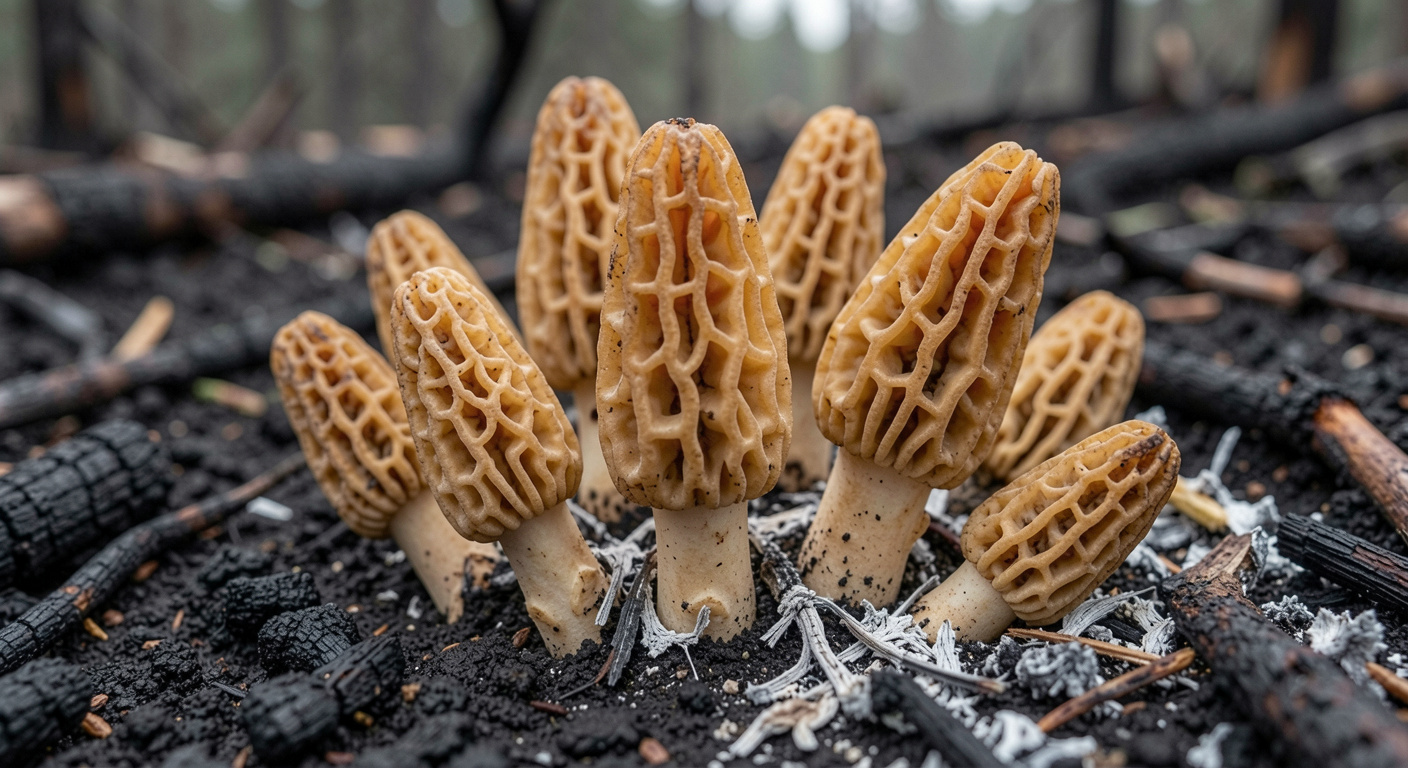
- May – July (> 4,000 ft / post-fire burn zones): The high-elevation burn window is when most serious PNW foragers shift their attention to the Cascades. First-year burn morels can produce hundreds of mushrooms per trip. [1] In Oregon, a 2023 burn near the McKenzie River corridor is expected to yield first- and second-year morels, while a zone of more than 400,000 acres burned in 2021 in the Fremont-Winema National Forest region is now in prime third- and fourth-year production. [4]
Oregon vs. Washington: Key Timing Differences
Oregon's east-side forests see less spring rain than the west Cascades, meaning burn zones there may need additional moisture before a flush is triggered — scout conditions carefully before committing to a drive. [4] Washington's Okanogan-Wenatchee National Forest, with its vast burn scars from multiple recent fire seasons, tends to be the state's most reliable destination for high-volume burn morel foraging. [3] In both states, east-facing slopes warm earlier in the morning, making them excellent first-stop scouts early in the elevation season. [4]
Burn-Site Foraging Regulations on USDA Forest Service Land
Understanding the permit rules before you go isn't just good citizenship — violations can result in citations and seizure of your harvest. Rules differ meaningfully between forest units.
Okanogan-Wenatchee National Forest (Washington)
The Okanogan-Wenatchee NF has some of the most straightforward rules for personal-use foragers:
- Personal harvest of up to five gallons per day is free with no monetary permit required. [3]
- A free Incidental Use Mushroom Information Sheet is required to be in your possession any time you are collecting mushrooms on National Forest land. [3] Pick one up at any ranger station.
- Mushrooms collected are for personal use only and cannot be sold or exchanged. [5]
- Campers may not stockpile mushrooms from day to day. [5]
- Harvesters are prohibited from entering closure areas — burn zones may have active hazard closures due to falling snags. [5]
- Motorized vehicles must stay on existing roads open to public use. [5]
"Proper identification and determination of whether a mushroom is edible is the responsibility of the picker." — USDA Forest Service, Okanogan-Wenatchee National Forest Personal Use Information Sheet [5]
The hazard note is worth emphasizing: burned areas contain snags and fire-damaged trees — blackened standing dead trees or green trees burned through at the base — that can fall without warning. [5] Always wear a hard hat or at minimum stay aware of overhead hazards when hunting recently burned terrain.
Willamette National Forest (Oregon)
The Willamette NF, which encompasses much of the western Cascades above the McKenzie and Santiam river drainages, has a lower free-harvest threshold:
- No permit or fee is required for quantities less than one gallon per person per day (except for matsutake). [2]
- Collecting more than one gallon — even for personal use — requires a permit. [2]
- All mushrooms must be cut in half when gathered under an incidental harvest permit, and harvest is for personal use only. [2]
- Critically: mushroom collection for personal or commercial use inside active fire closures is not allowed. [2] Check with a local ranger station for up-to-date closure information before every trip.
Checking Current Closures Before Every Trip
No matter which forest you're headed to, fire closures and restoration area designations can change between seasons — or even mid-season. Before leaving home:
| Resource | What to check |
|---|---|
| InciWeb (inciweb.nwcg.gov) | Current and recent fire perimeters, active closures |
| Local Ranger Station | Current mushroom permit requirements, area-specific closures |
| USFS Forest Unit Website | Seasonal orders, road closures, permit download links |
| State DNR / BLM Unit | Rules for state and BLM lands (different from National Forest) |
For a deeper dive into which forests offer the best overall foraging habitat beyond morel season, see our best mushroom foraging spots in the Pacific Northwest region-by-region guide.
Identifying True Morels vs. Dangerous Look-Alikes
This is where overconfidence kills. Morels have a reputation as an "easy" ID, and in isolation they are — but in the field, spring forests also contain several species that share the same habitat, the same season, and a superficially similar appearance.
The Three Look-Alikes to Know
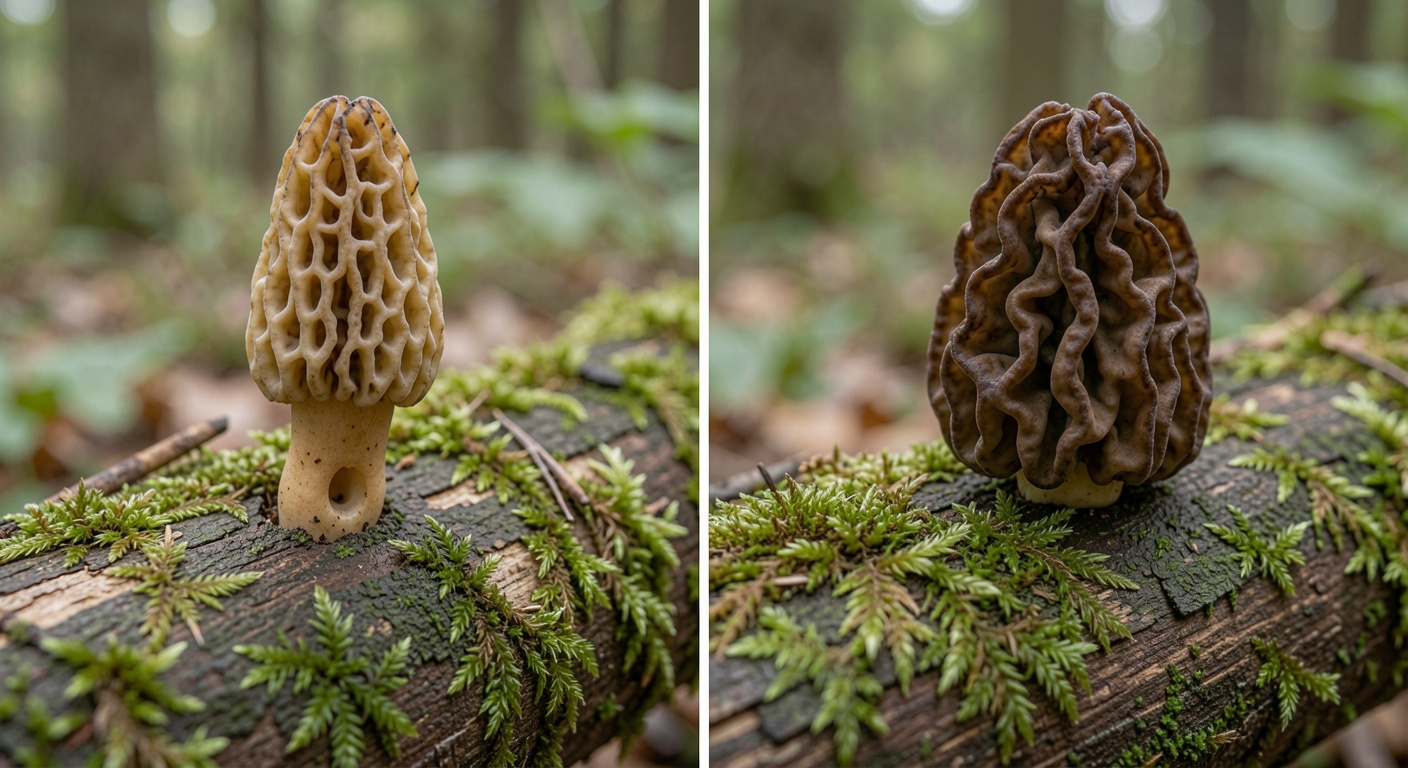
1. Gyromitra esculenta (Beefsteak Morel / False Morel) The most dangerous look-alike for Pacific Northwest foragers. G. esculenta often grows under conifers — balsam, pine, and spruce — and fruits in spring. [7] The cap is brain-like or saddle-shaped, with irregular lobes and deep wrinkles that look convoluted rather than honeycombed. Gyromitra esculenta contains the toxin gyromitrin, which transforms into hydrazine upon ingestion, potentially causing severe stomach distress, liver damage, and kidney damage within a few hours of eating. [8] Research published in 2026 also raised concerns that long-term consumption of related Gyromitra species could be associated with ALS-like nerve disease. [9] According to the Oregon Poison Center, approximately 20 false morel cases have been reported in Oregon in the last seven years. [9]
2. Gyromitra infula (Hooded False Morel) Resembles G. esculenta in size and color but grows on wood and has a 2–4-lobed, often saddle-shaped head. [6] Like other Gyromitra and Helvella species, it contains toxic, carcinogenic monomethylhydrazines. [6]
3. Verpas (Verpa bohemica / V. conica) These "false morels" are more closely related to true morels than Gyromitra is. The key field distinction: in true morels, the cap margin is fully attached to the stem. In verpas, the cap hangs free like a skirt, attached only at the very top. [10] Verpas are sold in some Seattle-area farmers markets and are eaten by some experienced foragers, but they are considered potentially toxic when raw and are not universally considered safe. [10]
"There are old mycophagists and there are brave mycophagists, but there are no old brave mycophagists." — Cascade Mycological Society [7]
The True Morel's Defining Characteristics
To confirm a true morel (Morchella spp.), check all of the following before the mushroom ever leaves the forest:
- Fully pitted, honeycombed cap — the ridges and pits should look like a three-dimensional sponge or honeycomb, not brain-like wrinkles
- Cap margin fully attached to stem — no free-hanging "skirt"
- Completely hollow interior — slice the mushroom in half lengthwise; both the cap and stem cavity should be entirely hollow and continuous
- White to pale cream stem — typically lighter than the cap
- Spring fruiting habitat — burned forests, disturbed soils, under dying elms or hardwoods
The Puget Sound Mycological Society (PSMS) — described by the Seattle Times as the country's biggest organization for mushroom enthusiasts — holds a free public identification clinic every Monday from 4 to 7 p.m. during mushroom season. [11] Attending at least one session before your first morel outing in a new area is strongly recommended.
For a broader look at dangerous look-alike pairs in the Pacific Northwest, the guide on chanterelle vs. Jack-o'-lantern mushroom identification uses the same head-to-head approach.
Building Your Morel Log: Strategy, Safety, and Gear
Spot-Finding Strategy for Burn Zones
When a forest fire kills conifer trees, the mycorrhizal fungi associated with those roots lose their host. In response, many of those fungal networks produce a massive fruiting the following spring — a last effort to spread spores before the mycelium dies. [1] This is why first-year burns are the most productive, with returns typically diminishing in years two and three. [1] Oregon's Cascade burn zones include areas that burned in 2021 now in their third and fourth year of potential production, 2022 fires entering second- and third-year production, and the 2023 McKenzie River corridor burn expected to see first- and second-year morels. [4]
Practical scouting checklist:
- Check fire perimeters from the previous year (InciWeb archives) and filter for burns of at least a few hundred acres — smaller burns can still produce but the density won't match
- Look for partial burns where the fire was patchy; the edge zones between scorched and unburned canopy are especially productive
- Scout east-facing slopes first — they warm earlier in the morning and often produce before adjacent north-facing terrain [4]
- Watch the 14-day precipitation forecast — a soaking rain on already-warm soil is the single best trigger for a new flush [1]
Essential Gear for a Burn-Zone Day
| Item | Why it matters |
|---|---|
| Hard hat or awareness of overhead | Snags in burned areas can fall without warning [5] |
| Mesh bag or open basket | Spores spread as you walk, seeding future finds |
| Paper bags for specimens | Keeps species separate for ID verification at home |
| Knife for clean cuts | Required on some NF units; better for mycelium health |
| Printed NF information sheet | Required on Okanogan-Wenatchee NF [3] |
| Offline map or GPS | Cell coverage in burn zones is often nonexistent |
| Field guide or photo-ID app | Non-negotiable for confirming any borderline specimen |
Logging Your Finds for Future Seasons
True morel spots — especially natural forest spots that don't depend on a one-time post-fire flush — can produce reliably year after year. Logging GPS coordinates, elevation, tree species nearby, soil moisture, and the date of your find builds a personal phenology record that becomes invaluable over time. Pairing that log with a photo of every find gives you a visual reference to compare across seasons and double-check any questionable IDs.
Our guide to 10 edible mushrooms every Pacific Northwest forager should learn first covers the full roster of species worth adding to your hunt list once morel season winds down.
Whether you're walking a low-elevation landscape patch in March or deep in an Okanogan burn zone in June, accurate identification is what separates a great day out from a dangerous one. The field guide app at[fieldguide.app] was built specifically for foragers in the Pacific Northwest: photograph any specimen, get an instant ID with edibility notes, look-alike warnings, and habitat context, then save the find to your personal log with a GPS pin. The free version covers the basics; unlocking photo-ID for $4.99 is the single most useful upgrade you can make before your next morel trip.
Frequently asked questions
When is morel season in Washington state?▾
Morel season in Washington runs from March through July. Low-elevation landscape morels appear first in March and early April, mid-elevation forest morels peak from April through June, and high-elevation burn-zone morels fruit from May through July as snowmelt exposes warmer soils.
Do I need a permit to pick morels in Oregon or Washington National Forests?▾
It depends on the forest unit. On the Okanogan-Wenatchee National Forest in Washington, personal harvest of up to five gallons per day is free but you must carry a free Incidental Use Mushroom Information Sheet. On the Willamette National Forest in Oregon, up to one gallon per day is free with no permit, but collecting more requires a paid permit. Always check with the local ranger station before going, as fire closures can prohibit harvest entirely in certain areas.
What makes burn sites so good for morel mushrooms?▾
When wildfire kills conifer trees, the mycorrhizal fungi connected to those roots lose their host. Many of those fungal networks respond by producing a massive fruiting the following spring in a last effort to spread spores. First-year burns are typically the most productive, with diminishing returns in years two and three.
What is the difference between a true morel and a false morel?▾
True morels (Morchella spp.) have a fully honeycomb-pitted cap whose margin is completely attached to the stem, and the interior is entirely hollow. False morels like Gyromitra esculenta have an irregular, brain-like or saddle-shaped wrinkled cap, and the cap may hang free or attach only at the top. Slicing a specimen in half lengthwise is the quickest field test — true morels are completely hollow throughout.
Is Gyromitra esculenta dangerous?▾
Yes. Gyromitra esculenta contains the toxin gyromitrin, which converts to hydrazine in the body and can cause severe gastrointestinal distress, liver damage, and kidney damage. Recent research has also raised concerns about long-term neurological effects from related species. The Oregon Poison Center reported approximately 20 false morel cases in the state over seven years. Never eat any mushroom with a wrinkled, brain-like cap without expert confirmation.
What soil temperature triggers morel fruiting?▾
Morel fruiting is strongly correlated with soil temperatures reaching approximately 50°F (10°C). Early in the season, warmth is the limiting factor; once soil is warm enough, moisture becomes the key trigger — a soaking rain on already-warm ground can produce an entirely new flush within days.
Sources
- Finding Morels in Washington — 2026 Season Guide & Map - Salish Mushrooms
- Willamette National Forest | Mushroom Permits | Forest Service
- Okanogan-Wenatchee National Forest | Forest Product Permits | Forest Service
- Morel Mushroom Season Oregon 2026 - Cascade Burn Zone Foraging Tracker | Mushroom Tracker
- Okanogan-Wenatchee National Forest FREE Personal Use Mushroom Information
- Gyromitra esculenta – Mushrooms Up! Edible and Poisonous Species of Coastal BC and the Pacific Northwest | UBC Beaty Museum
- The False "Beefsteak" Morel (Gyromitra esculenta) – Cascade Mycological Society
- Toxicity of Morels and False Morels in the Pacific Northwest - Salish Mushrooms
Keep reading
Ready to see it for yourself?
Back to home →