Comparison · 10 min read · June 1, 2026
How Accurate Are AI Mushroom Identification Apps? We Tested 5 Head-to-Head
If you've ever held a phone over a chanterelle and waited for an app to tell you it's safe to eat, you're not alone — but the science says you should think twice. A peer-reviewed study published in Clinical Toxicology in 2023 tested three of the most popular apps on real poisoning specimens and found the best performer was only correct 49% of the time, while the death cap (Amanita phalloides) was falsely identified by two of the three apps tested [1]. Here's everything you need to know before you trust a photo ID with your dinner.
- Top accuracy in peer-reviewed testing: Picture Mushroom led at 49% overall on real-world poisoning specimens — meaning it missed more than half [1].
- Worst-case risk: Amanita phalloides (the death cap, responsible for most fatal mushroom poisonings) was misidentified by multiple apps, including twice by the top-ranked app [1].
- Toxic look-alike danger: Studies show AI apps misidentify look-alikes to deadly genera like Amanita and Galerina more than 30% of the time [2].
- Common species fare better: For beginner-friendly, easily recognizable species, some AI tools reached 70%+ accuracy — but performance drops sharply on rarer or toxic mushrooms [3].
- App design varies widely: Some apps use photo AI; others use guided feature-selection closer to a traditional field guide. The method matters for accuracy and safety.
- Expert consensus: Poison control organizations and mycologists agree these tools should never be the sole basis for an eat/don't-eat decision [4].
| App | Method | Best-Tested Accuracy | A. phalloides Detection | Verdict |
|---|---|---|---|---|
| Picture Mushroom | Photo AI | 49% overall [1] | 60% [5] | Best of tested trio; still misses half |
| iNaturalist | Photo AI + community | 35% overall [1] | 27% [5] | Strong community but low solo accuracy |
| Mushroom Identificator | Photo AI | 35% overall [1] | Not reported | Tied for lowest accuracy |
| Shroomify | Feature-selection guide | Not in Clinical Tox study | N/A | Useful learning tool; not instant AI |
| Top-tier apps (range) | Photo AI | 65–80% (separate study) [2] | Varies | Better consumer apps but still 1-in-5 miss rate |
TL;DR: Every major mushroom ID app has a meaningful miss rate on toxic species — use them to learn and narrow options, not to make final eat/don't-eat calls.
What the Science Actually Says About Mushroom App Accuracy
The marketing language around mushroom apps tends to outpace the evidence. When researchers move beyond curated demo images and test apps against real-world poisoning specimens, the numbers look starkly different.
The Clinical Toxicology Study (2023): The Most Rigorous Head-to-Head Test
The most cited peer-reviewed benchmark to date was published in Clinical Toxicology in March 2023 by researchers from the Victorian Poisons Information Centre at Austin Health and the Royal Botanic Gardens Victoria [1]. Lead author Dr. Sarah E. Hodgson and colleagues designed the test around a sobering premise: they had observed a real-world "increase in poisonings after incorrect identification of poisonous species as edible, using these applications" [1].
The team tested Picture Mushroom (Next Vision Limited), Mushroom Identificator (Pierre Semedard), and iNaturalist (California Academy of Sciences) against 78 specimens drawn from actual poisoning cases reported to the Centre [1]. Each app was evaluated independently by three researchers using digital photographs.
Results [1]:
- Picture Mushroom: 49% correct (95% CI 0–100)
- Mushroom Identificator: 35% correct (95% CI 15–56)
- iNaturalist: 35% correct (95% CI 0–76)
The study's conclusion was unambiguous: these applications "are not reliable enough to exclude exposure to potentially poisonous mushrooms when used alone." [1]
The Death Cap Problem Is Especially Alarming
Amanita phalloides, the death cap, is responsible for the majority of fatal mushroom poisonings worldwide. In the Clinical Toxicology study, it was falsely identified — meaning labeled as something else — twice by Picture Mushroom and once by iNaturalist [1]. When looking specifically at poisonous mushroom identification, Picture Mushroom correctly identified 44% of toxic specimens and iNaturalist 40% [5]. For A. phalloides alone, Picture Mushroom reached a 60% detection rate while iNaturalist identified it correctly only 27% of the time [5].
That means in more than a third of cases, the leading app would give you wrong information about the deadliest mushroom in North American forests.
Other Studies Fill In the Picture
The Clinical Toxicology study isn't alone. A 2023 study in Fungal Diversity found that while apps performed reasonably on well-known edible species, they "faltered with rarer or toxic species," and look-alikes to dangerous genera like Amanita and Galerina were misidentified more than 30% of the time [2]. A separate analysis published in the Journal of Medical Toxicology tested four major apps using hundreds of real samples and found even the most accurate app delivered only 65–80% accuracy overall — meaning at least 1 in 5 samples was misidentified [2].
On the more optimistic side, a 2020 study in Fungal Ecology found that AI-powered ID tools achieved 70% or higher accuracy on common species — roughly comparable to a traditional field guide for everyday edibles [3]. The key caveat: performance degrades significantly the moment you move beyond the most recognizable, beginner-friendly species.
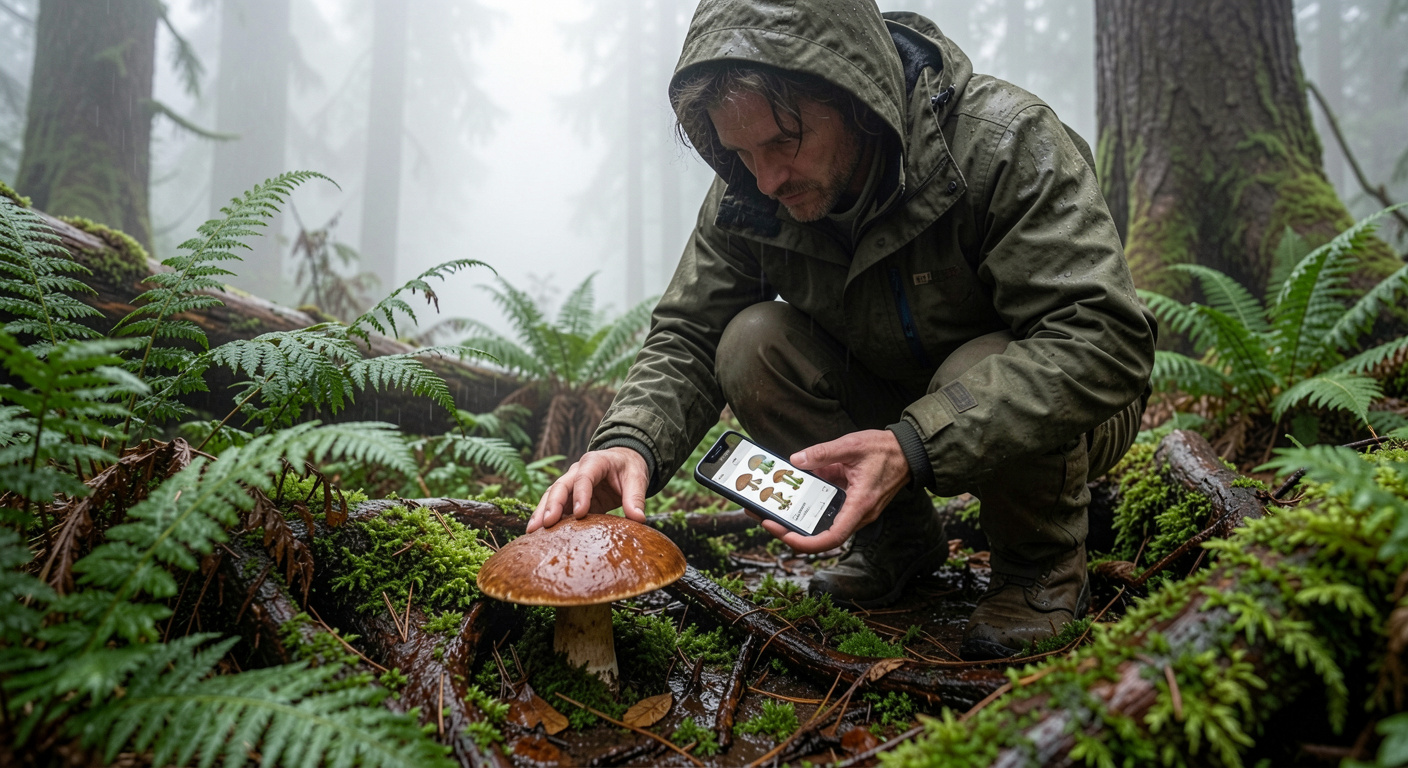
App-by-App Breakdown: What Each Tool Actually Does Well
Understanding how each app works helps you set realistic expectations. Not all mushroom apps use the same technology or aim for the same use case.
Picture Mushroom: Best Photo-AI Accuracy, But Still Falls Short
Picture Mushroom uses deep-learning image recognition to analyze uploaded photos against a database of thousands of species. In every published head-to-head test, it comes out ahead of competitors on raw accuracy [1]. The app provides edibility ratings, look-alike warnings, and habitat notes. Its strength is speed — snap a photo, get a result in seconds.
Its weakness is the same as all photo-AI apps: it identifies based on visual pattern alone, without knowing the smell, spore print color, bruising behavior, or precise habitat microcontext of your specimen — all cues a trained mycologist would use. For Pacific Northwest foragers eyeing chanterelles near old-growth Doug fir, the difference between a golden chanterelle and a toxic jack-o'-lantern isn't always visible in a single overhead photo. Check out our guide on Chanterelle vs. Jack-o'-Lantern Mushroom: How to Tell the Difference Before You Eat for why multi-feature confirmation is essential.
iNaturalist: Community Strength, Lower Solo Accuracy
iNaturalist is not strictly a mushroom app — it's a broad biodiversity platform backed by the California Academy of Sciences. Its photo-ID AI scored 35% in the Clinical Toxicology study [1], but the platform's real power is its community verification system: identifications are reviewed and refined by thousands of expert and enthusiast observers. For confident final IDs, a community-verified iNaturalist observation is more trustworthy than any solo AI result — but that verification takes hours or days, not the instant answer most foragers want in the field.
iNaturalist's geotagged observation database is also invaluable for understanding what species are being found in your specific region, making it a powerful research companion even if it's not your real-time safety net.
Shroomify and Feature-Selection Apps
Shroomify takes a fundamentally different approach — instead of snapping a photo, users select visual and habitat characteristics from a guided menu (cap color, gill type, habitat, season). This mirrors the decision-tree logic of a traditional field guide and is considered by many foragers to be an excellent educational tool for beginners [5]. Because it doesn't rely purely on a single image, it forces the user to observe multiple features — a practice that builds real ID skills over time. The trade-off: it's slower and requires knowing what to look for.
Mushroom Identificator and Niche Photo-AI Apps
Mushroom Identificator matched iNaturalist's 35% accuracy in the Clinical Toxicology study [1]. Like Picture Mushroom, it provides photo-based AI identification but with a smaller training dataset and less robust community backing. It's not a top pick for safety-focused identification.
| App | Core Technology | Offline Mode | Community Verification | Best Use Case |
|---|---|---|---|---|
| Picture Mushroom | Photo AI (deep learning) | Yes (premium) | Limited | Quick visual reference |
| iNaturalist | Photo AI + crowd | Partial | Yes (expert community) | Research & learning |
| Shroomify | Feature-selection guide | Yes | No | Skill-building for beginners |
| Mushroom Identificator | Photo AI | Limited | No | Secondary reference only |
| General purpose apps (e.g., Google Lens) | General image search | No | No | Not recommended for safety |
Why Photo ID Alone Is Genuinely Dangerous — And What to Use Instead
The core problem isn't that mushroom apps are bad software. It's that visual identification is insufficient for safe foraging even when humans do it, and AI cameras inherit all of those limitations plus a few new ones.
What Photos Miss That Mycologists Check
A trained mycologist confirming an edible species typically checks [4]:
- Spore print color (a critical differentiator for dozens of species pairs)
- Smell (e.g., anise in Agaricus subrufescens vs. almond in toxic Agaricus relatives)
- Bruising reaction (flesh color change when cut or pressed)
- Habitat microcontext — what trees are within 30 feet, soil type, elevation, moisture
- Base and volva — the cup at the base of the stem that distinguishes Amanita from everything else
A smartphone photo captures none of these. Poison control specialists at the American Association of Poison Control Centers are unequivocal: "It is NEVER safe to eat a wild mushroom unless a mushroom identification expert says so." [4]
"Mushroom identification applications may be useful future tools to assist clinical toxicologists and the general public in the accurate identification of mushroom species but, at present, are not reliable enough to exclude exposure to potentially poisonous mushrooms when used alone." — Hodgson, McKenzie, May & Greene, Clinical Toxicology, Victorian Poisons Information Centre & Royal Botanic Gardens Victoria [1]
The Layered Identification System That Works
Experienced foragers in the Pacific Northwest use apps as one layer in a multi-step confirmation process, not as the final word. A practical framework:
- Use an app (Picture Mushroom, iNaturalist, or a field-guide app) to generate a shortlist of candidate species.
- Cross-reference a regional field guide — Mushrooms of the Pacific Northwest by Steve Trudell is a widely used standard.
- Check every distinguishing feature: spore print, smell, gill attachment, stem base, habitat.
- Look up known look-alikes — especially for Amanita, Galerina, and Lepiota species.
- When in doubt, consult a local mycological society — groups like the Puget Sound Mycological Society offer forays and identification sessions.
If you're building your starter species list for PNW forests, our guide to 10 Edible Mushrooms Every Pacific Northwest Forager Should Learn First pairs well with any app-based workflow.
"There are old mushroom hunters, and there are bold mushroom hunters. There are no old, bold mushroom hunters!" — American Association of Poison Control Centers, Poison.org [4]
The Role of Location Data and Personal Logs
One genuinely valuable feature that modern apps offer — and that pure photo-AI often overshadows — is geotagged personal logging. Documenting exactly where and when you found a species builds a personal phenology map over seasons. Morel hunters in the Cascades know, for example, that elevation and snowmelt timing matter more than calendar date; a log of previous finds is worth more than any single photo ID. Our guide on when and where to find morel mushrooms in Washington and Oregon digs into exactly that kind of seasonal intelligence.
How to Choose the Right App — and How to Use It Safely
Given the accuracy limitations, the question isn't really "which app is best" but "how do I use these tools without getting hurt?"
Match the App to Your Skill Level
- Beginners: Start with feature-selection tools like Shroomify to build identification instincts. Use photo-AI only to generate a hypothesis, never a conclusion.
- Intermediate foragers: Layer iNaturalist's community expertise with a good field guide. Photograph caps, gills, stems, and base separately for each specimen.
- Experienced foragers: Photo-AI is a useful quick reference, but your own pattern recognition — built over dozens of confirmed IDs — should outweigh the app.
Red Flags to Watch in Any App
- No look-alike warnings displayed alongside the primary ID result
- No habitat or regional filter — an app that confidently IDs a Southeast Asian species for a PNW specimen isn't doing the work
- Confidence scores above 90% for visually ambiguous specimens — overconfidence is a bug, not a feature
- No disclaimer recommending expert confirmation before consumption
What a Purpose-Built Forager's App Should Include
The best field-guide apps combine AI-generated shortlists with deep edibility context — not just a name, but toxicity levels, regional look-alikes, and habitat context baked into every result. Combined with a personal location log that maps your finds over time, the app becomes a knowledge-building companion rather than a black-box oracle.
That's exactly the design philosophy behind our app. Built specifically for Pacific Northwest foragers, it layers photo ID with curated look-alike warnings for every regional species, offline access to habitat data, and a personal log with GPS tagging — so every find you make teaches you something for the next one. Download it free; unlock photo ID for $4.99.
Frequently asked questions
How accurate are mushroom identification apps?▾
In the most rigorous published test — a 2023 study in Clinical Toxicology using 78 real poisoning specimens — the best app (Picture Mushroom) was correct only 49% of the time. Mushroom Identificator and iNaturalist each scored 35%. A separate study found top consumer apps reaching 65–80% accuracy on wider samples, but that still means at least 1 in 5 identifications is wrong.
Can a mushroom app tell me if something is safe to eat?▾
No app is reliable enough to be the sole basis for an eat/don't-eat decision. Poison control organizations explicitly warn that it is never safe to eat a wild mushroom based on photo ID alone. Apps should be used as a hypothesis-generating starting point, confirmed with a field guide, multiple physical checks (spore print, smell, stem base), and ideally a regional expert or mycological society.
Which mushroom identification app is most accurate?▾
In peer-reviewed head-to-head testing, Picture Mushroom has consistently shown the highest accuracy among photo-AI apps, though it still correctly identified fewer than half of specimens in the Clinical Toxicology 2023 study. iNaturalist's community verification system adds a layer of reliability that solo AI photo-ID cannot match, but requires time to gather expert input.
Has the death cap (Amanita phalloides) been misidentified by mushroom apps?▾
Yes. In the 2023 Clinical Toxicology study, Amanita phalloides — the death cap responsible for most fatal mushroom poisonings — was falsely identified twice by Picture Mushroom and once by iNaturalist. Picture Mushroom only detected it correctly 60% of the time; iNaturalist only 27% of the time.
Is Shroomify safer than photo-AI apps like Picture Mushroom?▾
Shroomify uses a feature-selection approach rather than photo AI, guiding users to input observable characteristics (cap color, gill type, habitat) rather than relying on a single image. This forces multi-feature observation and is considered a good skill-building tool for beginners. However, no app should be considered a safety guarantee — always confirm with multiple methods.
What should I do if I think I've eaten a poisonous mushroom?▾
Call Poison Control immediately at 1-800-222-1222 (US). Save or photograph the mushroom if possible. Do not wait for symptoms to appear — some toxins, including those in Amanita phalloides, cause delayed onset and require early medical intervention. Never attempt to self-diagnose based on an app result after potential ingestion.
Sources
- A comparison of the accuracy of mushroom identification applications using digital photographs — Clinical Toxicology (PubMed)
- Mushroom Identification App Reviews: Which Actually Prevents Poisoning? — Bluntys
- Beginner's Guide to Mushroom Identification Apps for Safe Foraging — ShroomFan
- Mushroom poisoning: Don't invite 'the death angel' to dinner — Poison Control (poison.org)
- Is It Safe To Use Mushroom Foraging App? — Turbo Tasty
- A comparison of the accuracy of mushroom identification applications using digital photographs — Clinical Toxicology (Taylor & Francis full text)
Keep reading
Ready to see it for yourself?
Back to home →